Monday, October 23, 2006

Orange caterpillar parasite


Now this is an intriguing common name - mostly because it is an Australia wide one. But also because it doesn't just parasitize orange caterpillars.
It seems every state can lay claim to this lovely little animal. We see it swarming at outside lights in quite early spring, and I'm betting lots of well meaning souls have had a little prick from it when they pick it up to put it outside after it's managed to slip through the door to get to the even brighter lights of the great indoors.
(or is that just me? It doesn't sting - but jabs you with the ovipositor). Although this one is a boy - no ovipositor.
Anyway, it's Netelia producta. The Orange Caterpillar Parasite. Family Ichneumonidae.

Even cotton farmers, the Darth Vaders of entomology, are encouraged to leave this little cutie alone to get on with the job of enhancing integrated pest management by striking a balance with the Lepidoptera. Specifically Helicoverpa sp. (Cotton Bollworm and Native Budworm).

And the confession - the Netelia is just mad for this weedy Euphorbia hyberna. I keep a plant or two around and try to religiously weed out the rest. It is a magnet for native wasps and bees in spring, especially Netelia as it is such an early season wasp, when the weather can be very cold and unpredictable, and not much else is flowering. No pollen but they use it for an energy fix. And no introduced honeybees swarm at it at all. Very odd. But they are nothing if not perverse, the native Hymenoptera, so often favouring the flamboyant weed over the honest, jobbing native.
Not that I'm encouraging you to plant the weedy Euphorbia. When I find the local native that does the job, I'll let you know.

Friday, October 20, 2006

Dry rot


I had a lovely yarn last night to a dear friend who is in exile at the moment. Incarcerated in our fine national capital. This is for you, V!

I snapped this pic on a recent trip to the WA wheatbelt (I had the most wonderful time by the way - go if you can. There is so much to see). It's taken at Sanford Rocks, near Westonia, in salmon gum woodland. It shows termite tunnels, where they have totally demolished twigs and branches on the surface of the ground.

In more arid regions, like at Sanford Rocks, termites often take on the role that fungi does in higher rainfall areas, breaking down wood and leaf litter. Relatively undisturbed sites, like Sanford Rocks, are also home to the trapdoor spiders (Mygalomorphs) and the endearing but intimidating bulldog ants. But more of that later...

Tuesday, October 17, 2006

The bee's snooze


I had the day from hell today, but had one brief spin around the garden. That's not as lacking in challenge as it sounds. The garden is an acre or so.
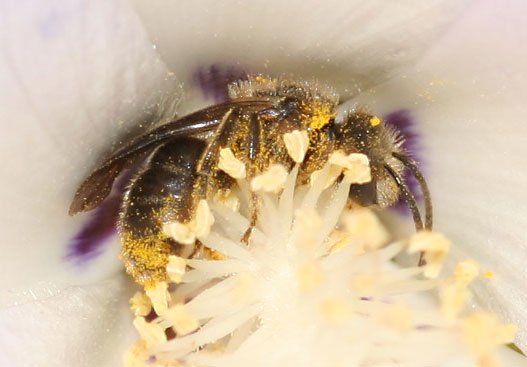
Anyway, cool sub 20 degree day today (my self-assessed standard is that bees and wasps are inactive here below 20 degrees) so I didn't expect to see many of my favourites - but true to form, asleep in Alyogyne angulata, was this little darling. It is always the first bee I see in spring. The girls nest in solitary fashion in the gound. The boys (and girls that haven't built the nest yet) sleep in flowers, like Ciceley Mary Barker's flower fairies. Sometimes there will be two or three in the one flower.
The extraordinary thing is that they favour A. angulata so particularly. I have several Alyogyne species, including the local A. huegelii. A. angulata is a recently described species from up Kalbarri way - at least 700 km away. So what does it offer that the other 3 species don't? I have no idea, but you'll always find them there while it flowers, and nowhere else.
This bee is probably from the family Halictidae, very likely a Lasioglossum sp. it is minute, by measure of Tarlton Rayment, being only approx. 5-6 mm.
You can kind of see this if you compare to the size of the stamens - this is not a large flowered native hibiscus.

Oh, and another thing - see all that pollen on this little tyke? Bees always have branched hairs on their body to trap pollen. While often not visible unless magnified, if an insect has pollen dusted on it like this - it's a bee, not a wasp!

OK, it's not the easiest, quickest method, but I don't think there is one. After all, bees are only vegetarian wasps.

Monday, October 16, 2006

The first post


This will be an occasional journal/diary/photoblog about nature, biodiversity, flora and fauna as I see it and snap it here in the far south-south west-west of Western Australia.

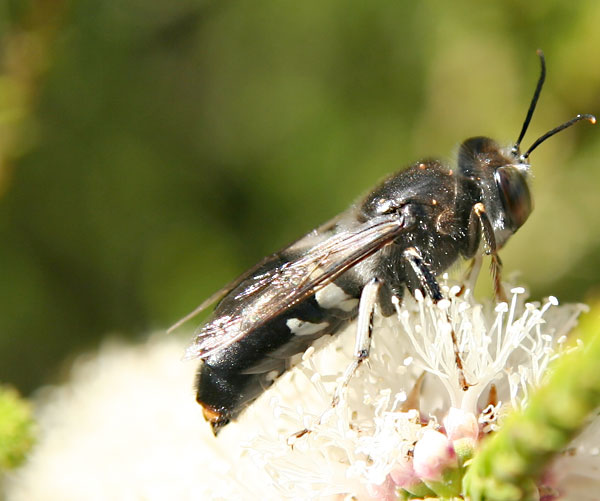
And this lovely animal? A very handsome flower wasp, family Tiphiidae. In this family, many of the females may be wingless. Admire the crisp white stripes on black, and nice orange tail. Photographed on Melaleuca huegelii, which like many Myrtaceae is a magnet for nectar and pollen feeders.

 
Creative Commons License
This work is licensed under a Creative Commons Attribution-NonCommercial-NoDerivs 2.5 License.