Showing posts with label insects. Show all posts

Monday, November 27, 2006

Home wrecker Pt III

And now the home maker!

After me huffing and puffing and blowing her house down big bad wolflike, my dauber has returned to effect repairs. I hope it's early days yet, as it looks a tad light weight. Haven't caught her in action yet, but she did rush over to see the damage as I stood there in consternation after my evil deed.


(of course this could be it, finito- she's washed her wings of it - I've read that when researchers have done nasty things like removed the food provisions and eggs from individual cells, the wasp still nonchalantly goes on plastering over and finishing off the empty cell. Now that's my kind of woman! Imperturbable)

Home wrecker Pt II

Well, a flash of memory last night just after I switched off the computer, and snail's gentle nudge in the comment on yesterday's post reminded me that I know perfectly well that my mud daubers must be Sphecid wasps.
They are more commonly called sand wasps, which is an awfully confusing and misleading name, many wasps in the family Sphecidae are mud daubers, dabbers, brickies and general pottery experts.

Individual species specialise in specific types of prey - so it's likely that this locally common dauber specialises in crab spiders, as she is quite a smallish wasp. Spiders are a great deal more abundant here than Lepidopteran larvae (due in no small part in my opinion to the overabundance of exotic pest paperwasps, Polistes sp).

Perhaps due to the abundance of baby food, the spider-specialty daubers are en masse on the farm - in every nook, cranny and crevice. Stand too still for too long and they will investigate any available orifice for nursery sites. Earholes are favoured.
They use driza-bones, boots, car engines, tools, tractor seats, garden gloves and probably more naturally occurring sites too (but I haven't seen that - maybe like swallows they have abandoned the natural for the much more convenient and abundant anthropogenic). Just like the Megachilid bees.
Which reminds me of another reason to love Sphecids - bees are commonly referred to as sphecoid like, and are believed to have derived from Sphecids. In effect, just Sphecids that provision their nurseries with pollen and nectar rather than arthropods.

But custom hasn't staled their infinity variety for me, and I never tire of their ingenious and often decorative creations. (A more tidy hausfrau than I could be driven into a cadenza. There's a nice thought).

Sunday, November 26, 2006

The home wrecker


I had to clean my verandah today. Unfortunately it has to be done from time to time. But I felt as guilty as the barbarian hordes sacking Rome's finest should have felt when I realized I had unwittingly destroyed the fine nursery of a mud dauber wasp.

She had carefully created every cell, and stocked each larder in it with the local spider-fare. It had progressed to the stage where the wasp larvae were quite well developed and visible. You can see one in the top right, attached to the meaty bits of the spider.
Most of the spiders seem to be crab or jumping spiders, something I've noticed before when I've had similar disturbing experiences, for example opening a window (well you have to have fresh air sometimes. Every window in the house is mortared with wasp nests).
Once when accidently peeling open a very fresh nest I was confronted with the most absolute rainbow of flower spiders, it was superb. Each one however beyond rescuscitation.

I'm a bit unsure about the identity of these locally very common mud daubers and potter wasps. The ones I see are always a plain black very discreet looking animal. Most Eumeninae, according to the literature, collect Lepidopteran larvae for their young, which these ones clearly don't. So obviously some homework for me to do.

Monday, November 13, 2006

More confusing flies


There are masses of these insects about the place at the moment, as our unseasonally warm weather continues to encourage all the invertebrates to swarm about like it's February already. I fantasise that I live in Cairns and can almost see lightning cracking over canefields.

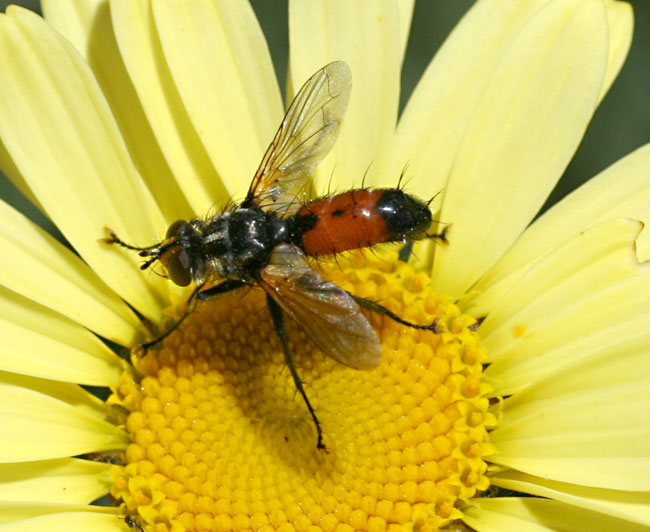
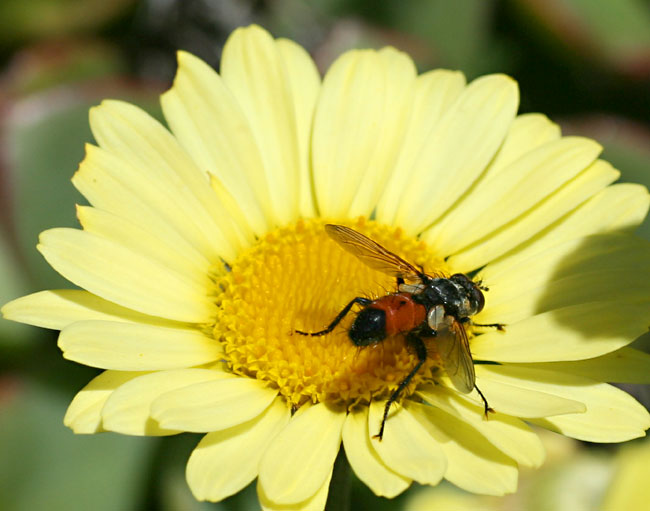
But I digress - at first glance I thought this was a tiny wasp, (it's appearing in sizes from tiny to small - 5-10 mm versions) it has all the right waspy colours and a nice wasp waist. Then a closer look made me see just two wings so I thought bee-fly. Then a very close look made me think
hoverfly.


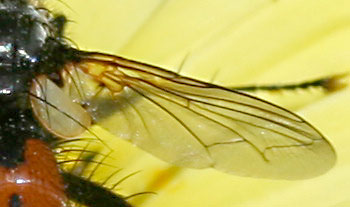
Hoverflies do the Batesian mimic thing very well, deterring predators by having that bee or wasp lookalike demeanour. Looking at a close-up of this flies wings, it's striking that the veins don't go all the way to the wing margin. This is characteristic of hoverflies, creating what is referred to as a "false margin". The other noticeable thing about this fly's wings is the scale over the halteres - a squama.
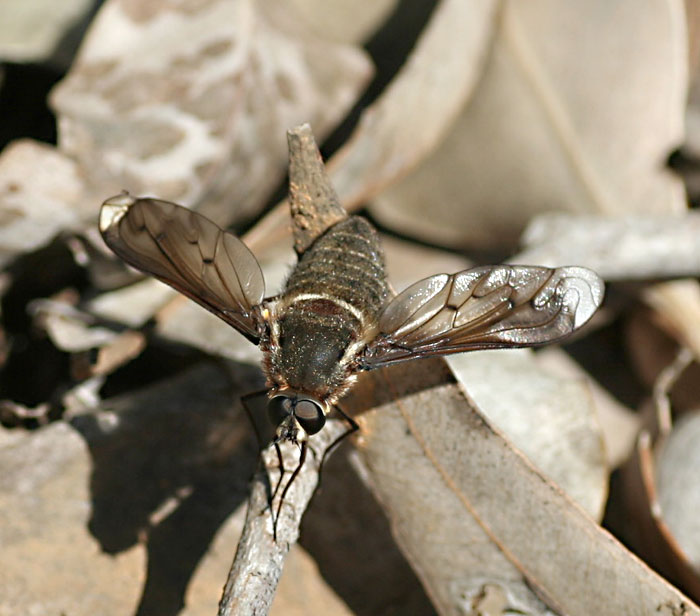
Here's a pic of a bee fly wing to emphasize the difference. This is the one from a week or so ago. It's a spectacular wing venation - just look at those lovely scrolls.


And here's a classic hoverfly wing - this is the introduced drone fly, Eriastalis tenax, the rat tailed maggot fly.


And here is today's fly. I'm not sure it's a hoverfly, so the mystery is still out there for the solving.


Sunday, November 12, 2006

More native bees


These tiny reed bees (Exoneura sp), are commonly found in the garden quite early in the season and all through summer into autumn. They really are small, hence the dodgy photo, only about 5mm. Obviously of an easy going and opportunistic nature as they are delighted with anything flowering, native or exotic (polylectic).
They are a long tongued bee, in the family Apidae, and enjoy visiting the Hebe flowers especially, where they can get the (very small) lion's share as the thin tubular Hebe flowers are largely inaccessible to honeybees.

Knowing that they like to nest in pithy stems I've carefully pruned everything in the garden so that plenty of likely nest sites are in the offing. Every year they've spurned my efforts with the local species of Kangaroo Paw, Anigozanthus flavidus, and I've never managed to sight them nesting anywhere. Not even in grasstree flowering stems, which I'm assured are their standard site.

Until this year - and true to their form (in the eastern states they like to nest in Lantana), they've chosen an introduced species, the very beautiful and luckily non-weedy South African Dierama sp. Every stem diligently left after pruning away last years' very tall fairy fishing rod flowers has been neatly drilled out and swept clean of sawdust, and occupied by one or more resident bees.
Exoneura are one of the semi-social (or semi-solitary, depending on your preference) bees, and two or more may occupy a nest and share chores. The larvae are tended and fed with pollen.

These were actually struggling for possession of this stem, sharing wasn't remotely on their minds. Short of ear tagging the bees I couldn't say which was the rightful possessor of the nest.

The other thing that's different about Exoneura is that they survive the winter, unlike most other native bees. Both the male and female spend the winter in the nest. And the cooler days, by the look of things, as they are only out and about when the temperatures are relatively balmy. So I can afford to get attached to these appealing little characters. Hurrah!

A nice article here
Aussie bees abuzz


Friday, November 03, 2006

Fly bee free


Bee flies and trigger plants. These are a few of my favourite things. Well, two. And there is a connection, happily.
This is a bee-fly - family Bombyliidae - and a true fly, not a bee. Interesting animals, bee-flies. Their larvae are parasitic on other larvae and eggs, often of Hymenoptera. The adults are nectivores, and pollinators par excellence. Their stout bodies are hairy and often dusted with pollen, just like native bees. They have hairless legs-and of course only two wings-so easy enough to spot from bees.
They also have a really distinctive flight pattern, hovering between bursts of incredibly rapid and buzzy horizontal flight.
And they are pollinators of trigger plants. Jan Taylor in his superbly illustrated book "Flower Power in the Bush and Garden" (not a title to inspire you to buy it but take my word for it, you'll love this book, especially if you're from WA. Out of print but keep your eyes open) explains that not many other insects visit Stylidium, "possibly because they are physically repelled by the trigger hitting them".
Indeedy. As you would be.
So our Bombyliidae are sturdy, intrepid little insects. Bless 'em. Not afraid of taking on the bullying triggers. And the size of Stylidium flower and the bee-fly that pollinates it are related. A bit of evolutionary flower power there.

But it gets even more interesting. The bee-fly is apparently no more keen on being knocked on the head by the trigger than any other insect, so it has evolved the habit of hovering over the flower, then landing upside down on the upper petals, thus not triggering the trigger.

Not to be outdone, the Stylidium has evolved all kinds of twisted and strangely angled petals. It can be very hard to tell which way is up. And not just for the bee-flies.

Ref.
Jan Taylor, Kangaroo Press 1989;
Flower Power in the Bush and Garden, The Fascinating Interrelationships Between Insects and Plants.

Monday, October 23, 2006

Orange caterpillar parasite


Now this is an intriguing common name - mostly because it is an Australia wide one. But also because it doesn't just parasitize orange caterpillars.
It seems every state can lay claim to this lovely little animal. We see it swarming at outside lights in quite early spring, and I'm betting lots of well meaning souls have had a little prick from it when they pick it up to put it outside after it's managed to slip through the door to get to the even brighter lights of the great indoors.
(or is that just me? It doesn't sting - but jabs you with the ovipositor). Although this one is a boy - no ovipositor.
Anyway, it's Netelia producta. The Orange Caterpillar Parasite. Family Ichneumonidae.

Even cotton farmers, the Darth Vaders of entomology, are encouraged to leave this little cutie alone to get on with the job of enhancing integrated pest management by striking a balance with the Lepidoptera. Specifically Helicoverpa sp. (Cotton Bollworm and Native Budworm).

And the confession - the Netelia is just mad for this weedy Euphorbia hyberna. I keep a plant or two around and try to religiously weed out the rest. It is a magnet for native wasps and bees in spring, especially Netelia as it is such an early season wasp, when the weather can be very cold and unpredictable, and not much else is flowering. No pollen but they use it for an energy fix. And no introduced honeybees swarm at it at all. Very odd. But they are nothing if not perverse, the native Hymenoptera, so often favouring the flamboyant weed over the honest, jobbing native.
Not that I'm encouraging you to plant the weedy Euphorbia. When I find the local native that does the job, I'll let you know.

Friday, October 20, 2006

Dry rot


I had a lovely yarn last night to a dear friend who is in exile at the moment. Incarcerated in our fine national capital. This is for you, V!

I snapped this pic on a recent trip to the WA wheatbelt (I had the most wonderful time by the way - go if you can. There is so much to see). It's taken at Sanford Rocks, near Westonia, in salmon gum woodland. It shows termite tunnels, where they have totally demolished twigs and branches on the surface of the ground.

In more arid regions, like at Sanford Rocks, termites often take on the role that fungi does in higher rainfall areas, breaking down wood and leaf litter. Relatively undisturbed sites, like Sanford Rocks, are also home to the trapdoor spiders (Mygalomorphs) and the endearing but intimidating bulldog ants. But more of that later...

Tuesday, October 17, 2006

The bee's snooze


I had the day from hell today, but had one brief spin around the garden. That's not as lacking in challenge as it sounds. The garden is an acre or so.
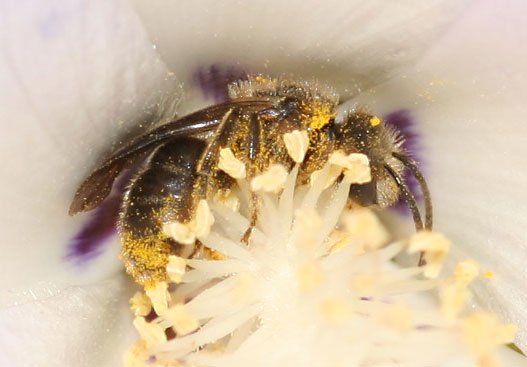
Anyway, cool sub 20 degree day today (my self-assessed standard is that bees and wasps are inactive here below 20 degrees) so I didn't expect to see many of my favourites - but true to form, asleep in Alyogyne angulata, was this little darling. It is always the first bee I see in spring. The girls nest in solitary fashion in the gound. The boys (and girls that haven't built the nest yet) sleep in flowers, like Ciceley Mary Barker's flower fairies. Sometimes there will be two or three in the one flower.
The extraordinary thing is that they favour A. angulata so particularly. I have several Alyogyne species, including the local A. huegelii. A. angulata is a recently described species from up Kalbarri way - at least 700 km away. So what does it offer that the other 3 species don't? I have no idea, but you'll always find them there while it flowers, and nowhere else.
This bee is probably from the family Halictidae, very likely a Lasioglossum sp. it is minute, by measure of Tarlton Rayment, being only approx. 5-6 mm.
You can kind of see this if you compare to the size of the stamens - this is not a large flowered native hibiscus.

Oh, and another thing - see all that pollen on this little tyke? Bees always have branched hairs on their body to trap pollen. While often not visible unless magnified, if an insect has pollen dusted on it like this - it's a bee, not a wasp!

OK, it's not the easiest, quickest method, but I don't think there is one. After all, bees are only vegetarian wasps.

Monday, October 16, 2006

The first post


This will be an occasional journal/diary/photoblog about nature, biodiversity, flora and fauna as I see it and snap it here in the far south-south west-west of Western Australia.

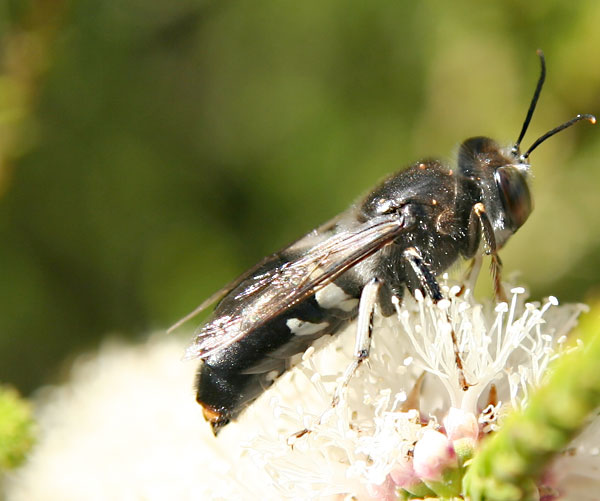
And this lovely animal? A very handsome flower wasp, family Tiphiidae. In this family, many of the females may be wingless. Admire the crisp white stripes on black, and nice orange tail. Photographed on Melaleuca huegelii, which like many Myrtaceae is a magnet for nectar and pollen feeders.

 
Creative Commons License
This work is licensed under a Creative Commons Attribution-NonCommercial-NoDerivs 2.5 License.