Showing posts with label wasps. Show all posts

Monday, November 27, 2006

Home wrecker Pt III

And now the home maker!

After me huffing and puffing and blowing her house down big bad wolflike, my dauber has returned to effect repairs. I hope it's early days yet, as it looks a tad light weight. Haven't caught her in action yet, but she did rush over to see the damage as I stood there in consternation after my evil deed.


(of course this could be it, finito- she's washed her wings of it - I've read that when researchers have done nasty things like removed the food provisions and eggs from individual cells, the wasp still nonchalantly goes on plastering over and finishing off the empty cell. Now that's my kind of woman! Imperturbable)

Home wrecker Pt II

Well, a flash of memory last night just after I switched off the computer, and snail's gentle nudge in the comment on yesterday's post reminded me that I know perfectly well that my mud daubers must be Sphecid wasps.
They are more commonly called sand wasps, which is an awfully confusing and misleading name, many wasps in the family Sphecidae are mud daubers, dabbers, brickies and general pottery experts.

Individual species specialise in specific types of prey - so it's likely that this locally common dauber specialises in crab spiders, as she is quite a smallish wasp. Spiders are a great deal more abundant here than Lepidopteran larvae (due in no small part in my opinion to the overabundance of exotic pest paperwasps, Polistes sp).

Perhaps due to the abundance of baby food, the spider-specialty daubers are en masse on the farm - in every nook, cranny and crevice. Stand too still for too long and they will investigate any available orifice for nursery sites. Earholes are favoured.
They use driza-bones, boots, car engines, tools, tractor seats, garden gloves and probably more naturally occurring sites too (but I haven't seen that - maybe like swallows they have abandoned the natural for the much more convenient and abundant anthropogenic). Just like the Megachilid bees.
Which reminds me of another reason to love Sphecids - bees are commonly referred to as sphecoid like, and are believed to have derived from Sphecids. In effect, just Sphecids that provision their nurseries with pollen and nectar rather than arthropods.

But custom hasn't staled their infinity variety for me, and I never tire of their ingenious and often decorative creations. (A more tidy hausfrau than I could be driven into a cadenza. There's a nice thought).

Sunday, November 26, 2006

The home wrecker


I had to clean my verandah today. Unfortunately it has to be done from time to time. But I felt as guilty as the barbarian hordes sacking Rome's finest should have felt when I realized I had unwittingly destroyed the fine nursery of a mud dauber wasp.

She had carefully created every cell, and stocked each larder in it with the local spider-fare. It had progressed to the stage where the wasp larvae were quite well developed and visible. You can see one in the top right, attached to the meaty bits of the spider.
Most of the spiders seem to be crab or jumping spiders, something I've noticed before when I've had similar disturbing experiences, for example opening a window (well you have to have fresh air sometimes. Every window in the house is mortared with wasp nests).
Once when accidently peeling open a very fresh nest I was confronted with the most absolute rainbow of flower spiders, it was superb. Each one however beyond rescuscitation.

I'm a bit unsure about the identity of these locally very common mud daubers and potter wasps. The ones I see are always a plain black very discreet looking animal. Most Eumeninae, according to the literature, collect Lepidopteran larvae for their young, which these ones clearly don't. So obviously some homework for me to do.

Monday, October 23, 2006

Orange caterpillar parasite


Now this is an intriguing common name - mostly because it is an Australia wide one. But also because it doesn't just parasitize orange caterpillars.
It seems every state can lay claim to this lovely little animal. We see it swarming at outside lights in quite early spring, and I'm betting lots of well meaning souls have had a little prick from it when they pick it up to put it outside after it's managed to slip through the door to get to the even brighter lights of the great indoors.
(or is that just me? It doesn't sting - but jabs you with the ovipositor). Although this one is a boy - no ovipositor.
Anyway, it's Netelia producta. The Orange Caterpillar Parasite. Family Ichneumonidae.

Even cotton farmers, the Darth Vaders of entomology, are encouraged to leave this little cutie alone to get on with the job of enhancing integrated pest management by striking a balance with the Lepidoptera. Specifically Helicoverpa sp. (Cotton Bollworm and Native Budworm).

And the confession - the Netelia is just mad for this weedy Euphorbia hyberna. I keep a plant or two around and try to religiously weed out the rest. It is a magnet for native wasps and bees in spring, especially Netelia as it is such an early season wasp, when the weather can be very cold and unpredictable, and not much else is flowering. No pollen but they use it for an energy fix. And no introduced honeybees swarm at it at all. Very odd. But they are nothing if not perverse, the native Hymenoptera, so often favouring the flamboyant weed over the honest, jobbing native.
Not that I'm encouraging you to plant the weedy Euphorbia. When I find the local native that does the job, I'll let you know.

Monday, October 16, 2006

The first post


This will be an occasional journal/diary/photoblog about nature, biodiversity, flora and fauna as I see it and snap it here in the far south-south west-west of Western Australia.

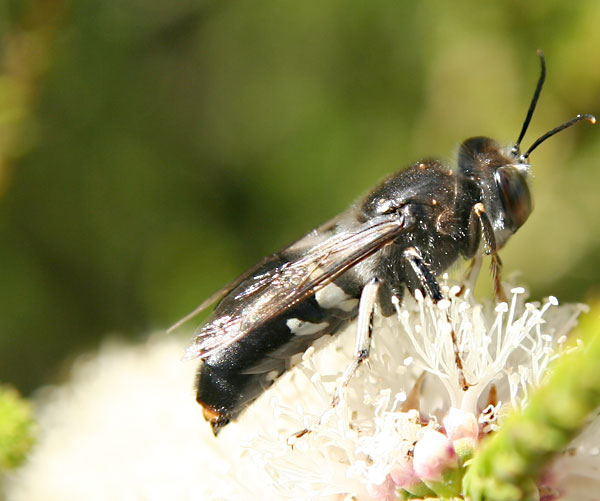
And this lovely animal? A very handsome flower wasp, family Tiphiidae. In this family, many of the females may be wingless. Admire the crisp white stripes on black, and nice orange tail. Photographed on Melaleuca huegelii, which like many Myrtaceae is a magnet for nectar and pollen feeders.

 
Creative Commons License
This work is licensed under a Creative Commons Attribution-NonCommercial-NoDerivs 2.5 License.